
How to Avoid Foreclosure in NJ: A Step-by-Step Guide
Falling behind on your mortgage can be frightening. You may be receiving letters from your lender, worrying about your credit, or wondering how much time you have before losing your home.
If you're facing foreclosure in New Jersey, you may have more options than you realize.
The most important thing is to understand where you stand, get reliable information, and act before important deadlines pass.
This guide explains seven practical steps New Jersey homeowners can take, including working with their mortgage company, finding free housing counseling, understanding legal protections, and considering whether selling their home makes sense.
If you've already received a foreclosure summons, complaint, or sheriff's sale notice, contact a qualified New Jersey foreclosure attorney promptly. Don't rely on general online timelines to determine your deadline.
Step 1: Understand the Foreclosure Process in New Jersey
New Jersey uses a judicial foreclosure process. This means a mortgage lender generally must pursue foreclosure through the court system rather than simply taking possession of a property after missed payments.
Although every situation is different, the process commonly involves:
- Missed mortgage payments: The homeowner falls behind and receives notices from the mortgage servicer.
- Pre-foreclosure notices: The lender provides required notices before pursuing a foreclosure action.
- Foreclosure complaint: The lender files a lawsuit in New Jersey Superior Court.
- Opportunity to respond: The homeowner receives legal documents and has a deadline to respond.
- Court proceedings and judgment: If the foreclosure proceeds, the lender may obtain a final judgment.
- Sheriff's sale: The property may eventually be scheduled for sale.
Under federal mortgage servicing rules, foreclosure generally cannot be initiated until a borrower is more than 120 days delinquent, although exceptions exist.
Once a New Jersey foreclosure lawsuit has been filed, deadlines become especially important. For example, the ordinary period to answer a foreclosure complaint is generally 35 days after service, although individual circumstances and court orders can affect the process.
What you should do: Gather every notice you've received, identify your current stage, and write down any response or sale deadlines.
For official information, visit the New Jersey Courts foreclosure FAQs.
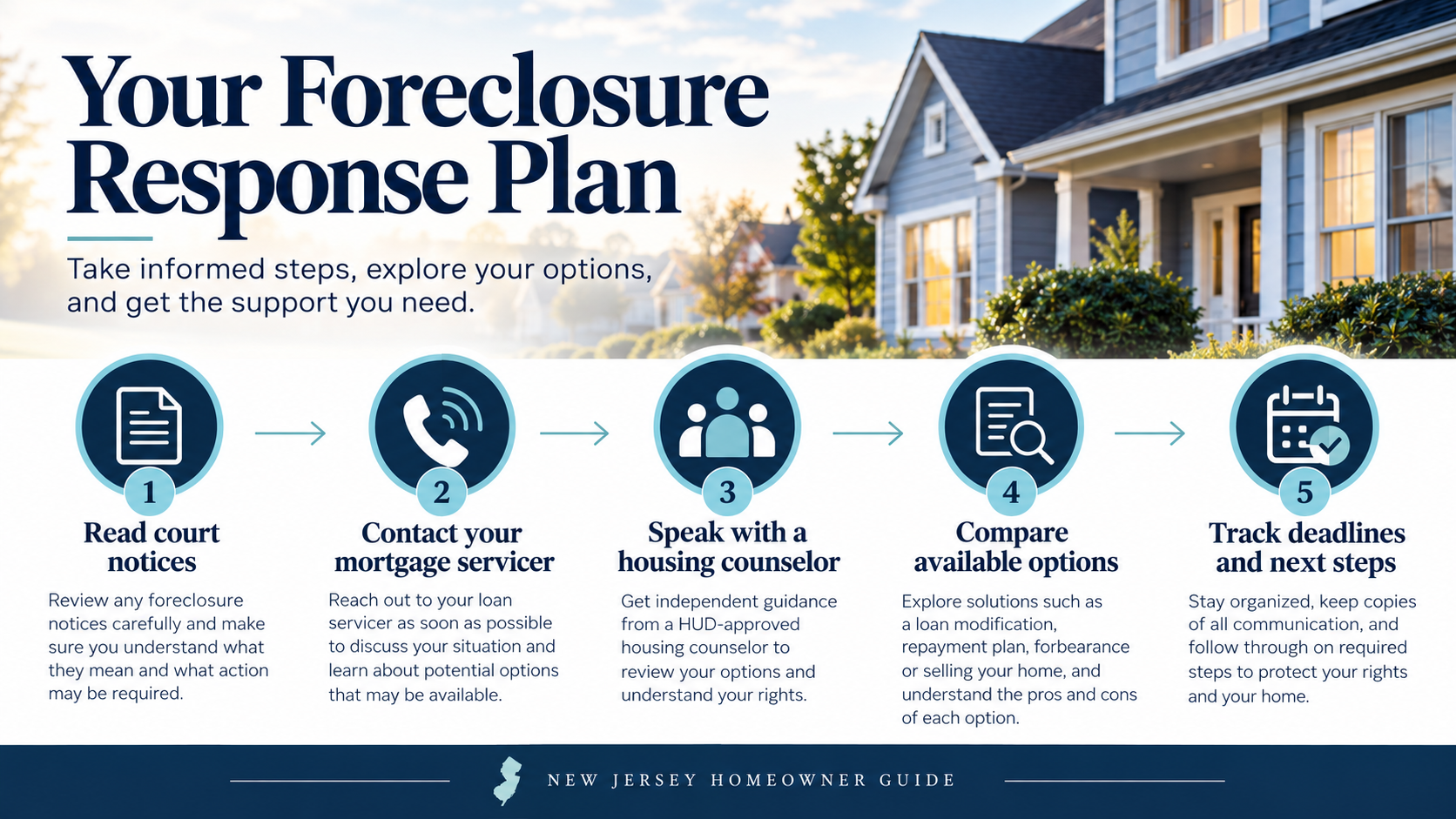
Five practical steps New Jersey homeowners can take when facing foreclosure.
Step 2: Contact Your Mortgage Servicer Immediately
You do not need to wait until foreclosure begins to ask for help.
Your mortgage servicer—the company that collects your monthly mortgage payments—may have options designed to help borrowers experiencing financial hardship.
Depending on your loan, financial circumstances, and eligibility, those options may include:
- Forbearance: A temporary reduction or pause in payments, with a plan for addressing the missed amounts afterward.
- Repayment plan: An arrangement to catch up on overdue payments over time.
- Loan modification: A change to certain mortgage terms that may make payments more manageable.
- Refinancing: A potential option for eligible borrowers, although qualifying can become more difficult after missed payments.
When contacting your mortgage servicer, ask:
- What is my total past-due balance?
- What assistance programs are available for my loan?
- Can I submit a loss mitigation application?
- What documents do you need from me?
- Is a foreclosure action or sale currently scheduled?
- When should I expect a written response?
Keep notes from every conversation, including dates, names, reference numbers, and promised follow-up actions.
The Consumer Financial Protection Bureau's foreclosure assistance guide explains how to work with your servicer and request help.
Helpful tip: Submit complete paperwork as early as possible. Certain federal protections depend on when your mortgage servicer receives a complete application.
Step 3: Explore Free Housing Counseling and Legal Assistance
One of the most valuable resources for New Jersey homeowners is professional foreclosure counseling.
The New Jersey Housing and Mortgage Finance Agency (NJHMFA) supports foreclosure prevention counseling through participating housing counseling agencies.
These counselors can help homeowners understand mortgage assistance options, organize financial information, communicate with lenders, and evaluate possible solutions.
Start with the NJHMFA Foreclosure Prevention Counseling program.
You can also find a participating New Jersey housing counselor.
What about foreclosure mediation?
New Jersey also has a foreclosure mediation process for qualifying homeowners with active foreclosure cases.
Eligibility requirements and deadlines apply. NJHMFA advises that eligible homeowners generally must request mediation within 60 days after service of the foreclosure summons and complaint, unless a court orders otherwise.
A housing counselor or foreclosure attorney can help you determine whether mediation is appropriate.
When should you contact an attorney?
Consider obtaining legal advice immediately if:
- You have been served with foreclosure court papers.
- A sheriff's sale has been scheduled.
- You believe the mortgage balance or foreclosure filing is incorrect.
- You are considering bankruptcy.
- You have questions about ownership, liens, inheritance, or your legal rights.
A housing counselor can help with mortgage assistance, but cannot replace legal representation.
Step 4: Compare Your Alternatives Before Making a Decision
There is no single solution that works for every homeowner.
Your best option depends on how far behind you are, whether your financial hardship is temporary or ongoing, how much equity you have, and whether you want to remain in the property.
Option A: Keep the home
If your financial difficulties are temporary, a repayment plan, modification, or another lender-approved arrangement may help you stay.
Option B: Sell through a real estate agent
If you have sufficient time and the property is marketable, listing with an experienced local real estate agent may help you reach a broad pool of buyers.
You should account for commissions, repairs, carrying costs, and the time needed to close.
Option C: Sell the property as-is
Some homeowners prefer to sell without completing repairs or preparing the property for traditional showings.
An as-is sale may be worth considering when a property needs significant work or the owner wants a simpler transaction.
However, an as-is sale does not automatically stop foreclosure. The sale must be completed in time, and any mortgage payoff, liens, and required approvals must be addressed.
Option D: Consider a short sale
If your home is worth less than the amount owed, your mortgage servicer may consider a short sale.
A short sale typically requires lender approval and may have credit, tax, and remaining-debt consequences.
Option E: Explore a deed in lieu of foreclosure
In some circumstances, a lender may agree to accept ownership of the property instead of completing the foreclosure process.
This requires lender approval and can have important legal and financial consequences.
Before selecting an option, speak with your lender, a qualified housing counselor, and appropriate legal or tax professionals.
The CFPB's mortgage options guide provides an independent overview.

Compare five options for New Jersey homeowners facing foreclosure, including potential benefits and challenges.
Step 5: Consider Selling Your Home Before Foreclosure
For some homeowners, selling the property is a practical way to resolve a difficult financial situation.
That doesn't mean selling is always the best choice.
If you can afford to keep your home through an assistance program or mortgage modification, that may be preferable.
But if your financial circumstances have permanently changed, continuing to accumulate missed payments, fees, and other expenses may make the situation more difficult.
Questions to ask before selling
- How much is my home realistically worth?
- What is the current mortgage payoff?
- Are there other mortgages, liens, or unpaid property taxes?
- How much time remains before a possible foreclosure sale?
- What repairs would be needed for a traditional sale?
- What would I receive after all closing costs and obligations?
Traditional sale versus cash sale
A traditional sale may generate a higher purchase price, especially for a well-maintained property with sufficient marketing time.
A direct cash sale may offer greater flexibility when repairs, financing contingencies, or scheduling are concerns.
However, a cash offer may be lower than the price achievable through a traditional listing. Compare your estimated net proceeds, not just the headline offer.
How KJH Properties can help
At KJH Properties, we buy houses throughout New Jersey, including properties that may need repairs or are facing difficult circumstances.
If you're considering selling, we can discuss your situation and explain what a direct purchase might look like.
Selling a home in Bergen County? See your local options in Glen Rock, Paramus, Ridgewood, or Ramsey.
There's no obligation to accept an offer, and we encourage homeowners to compare their options.
Important: We cannot guarantee that a sale will stop foreclosure or close before a court or sheriff's sale deadline. Those details must be confirmed based on your specific circumstances.
Step 6: Protect Yourself From Future Financial Problems
Whether you keep your home or decide to sell, having a financial plan can help you move forward.
Consider these steps:
Create a realistic monthly budget. Identify essential expenses, outstanding debts, and areas where you can reduce costs.
Build an emergency reserve when possible. Even a small financial cushion can help with unexpected repairs or temporary income interruptions.
Communicate early with creditors. Waiting until payments are seriously overdue can limit available solutions.
Review your credit reports. Check for inaccurate information and understand how missed payments may affect future borrowing.
Be cautious of foreclosure rescue scams. Avoid companies that guarantee results, demand large upfront fees for mortgage relief, or pressure you to sign documents you do not understand.
The CFPB's mortgage help resources explain common warning signs and ways to obtain legitimate assistance.
Step 7: Use Trusted New Jersey Foreclosure Resources
You do not have to navigate the foreclosure process alone.
These established resources are useful starting points:
New Jersey Courts
Official information about foreclosure procedures, court documents, and homeowner questions.
Visit New Jersey Courts foreclosure FAQs
New Jersey Housing and Mortgage Finance Agency
Information about foreclosure prevention counseling and assistance through participating agencies.
Visit NJHMFA Foreclosure Prevention Counseling
Consumer Financial Protection Bureau
Federal consumer guidance on mortgage servicing, foreclosure prevention, and borrower protections.
HUD-Approved Housing Counselors
Independent housing counselors can help you understand your financial situation and communicate with your mortgage servicer.
Find housing counseling assistance
If you have an active foreclosure case, prioritize any court deadlines over general information found online.
Frequently Asked Questions About Foreclosure in New Jersey
Can I stop foreclosure once it has started?
Possibly. Depending on the circumstances, options may include reinstating the loan, reaching an agreement with the lender, obtaining an approved mortgage assistance arrangement, or completing a qualifying sale. The available options change as the case progresses.
Can I sell my house while it is in foreclosure?
In many cases, homeowners can pursue a sale while foreclosure proceedings are underway. However, the sale must satisfy applicable mortgage and title requirements, and a pending sale does not automatically postpone a sheriff's sale.
How long does foreclosure take in New Jersey?
There is no single timeline. The duration depends on the loan, notices, court proceedings, homeowner responses, and other circumstances. Check your actual case documents rather than relying on a general estimate.
Does foreclosure affect my credit?
Foreclosure and missed mortgage payments can negatively affect your credit. The impact depends on your overall credit history and the information reported.
Should I sell my house or try to keep it?
Start by understanding whether your financial hardship is temporary or permanent. A housing counselor can help you evaluate ways to keep your home. If selling is more appropriate, compare traditional listing and direct-sale options before making a decision.
Final Thoughts: You Have Options
Facing foreclosure in New Jersey can be overwhelming, but you don't have to make a decision without understanding your choices.
Start by contacting your mortgage servicer, getting independent housing counseling, reviewing your legal deadlines, and comparing the options available to you.
If keeping your home is possible and financially sustainable, explore that path first.
If selling makes more sense, take time to understand your property's value, mortgage payoff, closing costs, and available timeline.
KJH Properties is here if you'd like to explore selling your New Jersey home as-is. We're happy to discuss your situation and explain our process without pressure.
Disclaimer: This article is for general educational purposes and is not legal, financial, or tax advice. Foreclosure laws, assistance programs, and individual circumstances can change. Consult qualified professionals about your specific situation.

Falling behind on your mortgage can be frightening. You may be receiving letters from your lender, worrying about your credit, or wondering how much time you have before losing your home.
If you're facing foreclosure in New Jersey, you may have more options than you realize.
The most important thing is to understand where you stand, get reliable information, and act before important deadlines pass.
This guide explains seven practical steps New Jersey homeowners can take, including working with their mortgage company, finding free housing counseling, understanding legal protections, and considering whether selling their home makes sense.
If you've already received a foreclosure summons, complaint, or sheriff's sale notice, contact a qualified New Jersey foreclosure attorney promptly. Don't rely on general online timelines to determine your deadline.
Step 1: Understand the Foreclosure Process in New Jersey
New Jersey uses a judicial foreclosure process. This means a mortgage lender generally must pursue foreclosure through the court system rather than simply taking possession of a property after missed payments.
Although every situation is different, the process commonly involves:
- Missed mortgage payments: The homeowner falls behind and receives notices from the mortgage servicer.
- Pre-foreclosure notices: The lender provides required notices before pursuing a foreclosure action.
- Foreclosure complaint: The lender files a lawsuit in New Jersey Superior Court.
- Opportunity to respond: The homeowner receives legal documents and has a deadline to respond.
- Court proceedings and judgment: If the foreclosure proceeds, the lender may obtain a final judgment.
- Sheriff's sale: The property may eventually be scheduled for sale.
Under federal mortgage servicing rules, foreclosure generally cannot be initiated until a borrower is more than 120 days delinquent, although exceptions exist.
Once a New Jersey foreclosure lawsuit has been filed, deadlines become especially important. For example, the ordinary period to answer a foreclosure complaint is generally 35 days after service, although individual circumstances and court orders can affect the process.
What you should do: Gather every notice you've received, identify your current stage, and write down any response or sale deadlines.
For official information, visit the New Jersey Courts foreclosure FAQs.
Five practical steps New Jersey homeowners can take when facing foreclosure.
Step 2: Contact Your Mortgage Servicer Immediately
You do not need to wait until foreclosure begins to ask for help.
Your mortgage servicer—the company that collects your monthly mortgage payments—may have options designed to help borrowers experiencing financial hardship.
Depending on your loan, financial circumstances, and eligibility, those options may include:
- Forbearance: A temporary reduction or pause in payments, with a plan for addressing the missed amounts afterward.
- Repayment plan: An arrangement to catch up on overdue payments over time.
- Loan modification: A change to certain mortgage terms that may make payments more manageable.
- Refinancing: A potential option for eligible borrowers, although qualifying can become more difficult after missed payments.
When contacting your mortgage servicer, ask:
- What is my total past-due balance?
- What assistance programs are available for my loan?
- Can I submit a loss mitigation application?
- What documents do you need from me?
- Is a foreclosure action or sale currently scheduled?
- When should I expect a written response?
Keep notes from every conversation, including dates, names, reference numbers, and promised follow-up actions.
The Consumer Financial Protection Bureau's foreclosure assistance guide explains how to work with your servicer and request help.
Helpful tip: Submit complete paperwork as early as possible. Certain federal protections depend on when your mortgage servicer receives a complete application.
Step 3: Explore Free Housing Counseling and Legal Assistance
One of the most valuable resources for New Jersey homeowners is professional foreclosure counseling.
The New Jersey Housing and Mortgage Finance Agency (NJHMFA) supports foreclosure prevention counseling through participating housing counseling agencies.
These counselors can help homeowners understand mortgage assistance options, organize financial information, communicate with lenders, and evaluate possible solutions.
Start with the NJHMFA Foreclosure Prevention Counseling program.
You can also find a participating New Jersey housing counselor.
What about foreclosure mediation?
New Jersey also has a foreclosure mediation process for qualifying homeowners with active foreclosure cases.
Eligibility requirements and deadlines apply. NJHMFA advises that eligible homeowners generally must request mediation within 60 days after service of the foreclosure summons and complaint, unless a court orders otherwise.
A housing counselor or foreclosure attorney can help you determine whether mediation is appropriate.
When should you contact an attorney?
Consider obtaining legal advice immediately if:
- You have been served with foreclosure court papers.
- A sheriff's sale has been scheduled.
- You believe the mortgage balance or foreclosure filing is incorrect.
- You are considering bankruptcy.
- You have questions about ownership, liens, inheritance, or your legal rights.
A housing counselor can help with mortgage assistance, but cannot replace legal representation.
Step 4: Compare Your Alternatives Before Making a Decision
There is no single solution that works for every homeowner.
Your best option depends on how far behind you are, whether your financial hardship is temporary or ongoing, how much equity you have, and whether you want to remain in the property.
Option A: Keep the home
If your financial difficulties are temporary, a repayment plan, modification, or another lender-approved arrangement may help you stay.
Option B: Sell through a real estate agent
If you have sufficient time and the property is marketable, listing with an experienced local real estate agent may help you reach a broad pool of buyers.
You should account for commissions, repairs, carrying costs, and the time needed to close.
Option C: Sell the property as-is
Some homeowners prefer to sell without completing repairs or preparing the property for traditional showings.
An as-is sale may be worth considering when a property needs significant work or the owner wants a simpler transaction.
However, an as-is sale does not automatically stop foreclosure. The sale must be completed in time, and any mortgage payoff, liens, and required approvals must be addressed.
Option D: Consider a short sale
If your home is worth less than the amount owed, your mortgage servicer may consider a short sale.
A short sale typically requires lender approval and may have credit, tax, and remaining-debt consequences.
Option E: Explore a deed in lieu of foreclosure
In some circumstances, a lender may agree to accept ownership of the property instead of completing the foreclosure process.
This requires lender approval and can have important legal and financial consequences.
Before selecting an option, speak with your lender, a qualified housing counselor, and appropriate legal or tax professionals.
The CFPB's mortgage options guide provides an independent overview.
Compare five options for New Jersey homeowners facing foreclosure, including potential benefits and challenges.
Step 5: Consider Selling Your Home Before Foreclosure
For some homeowners, selling the property is a practical way to resolve a difficult financial situation.
That doesn't mean selling is always the best choice.
If you can afford to keep your home through an assistance program or mortgage modification, that may be preferable.
But if your financial circumstances have permanently changed, continuing to accumulate missed payments, fees, and other expenses may make the situation more difficult.
Questions to ask before selling
- How much is my home realistically worth?
- What is the current mortgage payoff?
- Are there other mortgages, liens, or unpaid property taxes?
- How much time remains before a possible foreclosure sale?
- What repairs would be needed for a traditional sale?
- What would I receive after all closing costs and obligations?
Traditional sale versus cash sale
A traditional sale may generate a higher purchase price, especially for a well-maintained property with sufficient marketing time.
A direct cash sale may offer greater flexibility when repairs, financing contingencies, or scheduling are concerns.
However, a cash offer may be lower than the price achievable through a traditional listing. Compare your estimated net proceeds, not just the headline offer.
How KJH Properties can help
At KJH Properties, we buy houses throughout New Jersey, including properties that may need repairs or are facing difficult circumstances.
If you're considering selling, we can discuss your situation and explain what a direct purchase might look like.
Selling a home in Bergen County? See your local options in Glen Rock, Paramus, Ridgewood, or Ramsey.
There's no obligation to accept an offer, and we encourage homeowners to compare their options.
Important: We cannot guarantee that a sale will stop foreclosure or close before a court or sheriff's sale deadline. Those details must be confirmed based on your specific circumstances.
Step 6: Protect Yourself From Future Financial Problems
Whether you keep your home or decide to sell, having a financial plan can help you move forward.
Consider these steps:
Create a realistic monthly budget. Identify essential expenses, outstanding debts, and areas where you can reduce costs.
Build an emergency reserve when possible. Even a small financial cushion can help with unexpected repairs or temporary income interruptions.
Communicate early with creditors. Waiting until payments are seriously overdue can limit available solutions.
Review your credit reports. Check for inaccurate information and understand how missed payments may affect future borrowing.
Be cautious of foreclosure rescue scams. Avoid companies that guarantee results, demand large upfront fees for mortgage relief, or pressure you to sign documents you do not understand.
The CFPB's mortgage help resources explain common warning signs and ways to obtain legitimate assistance.
Step 7: Use Trusted New Jersey Foreclosure Resources
You do not have to navigate the foreclosure process alone.
These established resources are useful starting points:
New Jersey Courts
Official information about foreclosure procedures, court documents, and homeowner questions.
Visit New Jersey Courts foreclosure FAQs
New Jersey Housing and Mortgage Finance Agency
Information about foreclosure prevention counseling and assistance through participating agencies.
Visit NJHMFA Foreclosure Prevention Counseling
Consumer Financial Protection Bureau
Federal consumer guidance on mortgage servicing, foreclosure prevention, and borrower protections.
HUD-Approved Housing Counselors
Independent housing counselors can help you understand your financial situation and communicate with your mortgage servicer.
Find housing counseling assistance
If you have an active foreclosure case, prioritize any court deadlines over general information found online.
Frequently Asked Questions About Foreclosure in New Jersey
Can I stop foreclosure once it has started?
Possibly. Depending on the circumstances, options may include reinstating the loan, reaching an agreement with the lender, obtaining an approved mortgage assistance arrangement, or completing a qualifying sale. The available options change as the case progresses.
Can I sell my house while it is in foreclosure?
In many cases, homeowners can pursue a sale while foreclosure proceedings are underway. However, the sale must satisfy applicable mortgage and title requirements, and a pending sale does not automatically postpone a sheriff's sale.
How long does foreclosure take in New Jersey?
There is no single timeline. The duration depends on the loan, notices, court proceedings, homeowner responses, and other circumstances. Check your actual case documents rather than relying on a general estimate.
Does foreclosure affect my credit?
Foreclosure and missed mortgage payments can negatively affect your credit. The impact depends on your overall credit history and the information reported.
Should I sell my house or try to keep it?
Start by understanding whether your financial hardship is temporary or permanent. A housing counselor can help you evaluate ways to keep your home. If selling is more appropriate, compare traditional listing and direct-sale options before making a decision.
Final Thoughts: You Have Options
Facing foreclosure in New Jersey can be overwhelming, but you don't have to make a decision without understanding your choices.
Start by contacting your mortgage servicer, getting independent housing counseling, reviewing your legal deadlines, and comparing the options available to you.
If keeping your home is possible and financially sustainable, explore that path first.
If selling makes more sense, take time to understand your property's value, mortgage payoff, closing costs, and available timeline.
KJH Properties is here if you'd like to explore selling your New Jersey home as-is. We're happy to discuss your situation and explain our process without pressure.
Disclaimer: This article is for general educational purposes and is not legal, financial, or tax advice. Foreclosure laws, assistance programs, and individual circumstances can change. Consult qualified professionals about your specific situation.